The room without witnesses

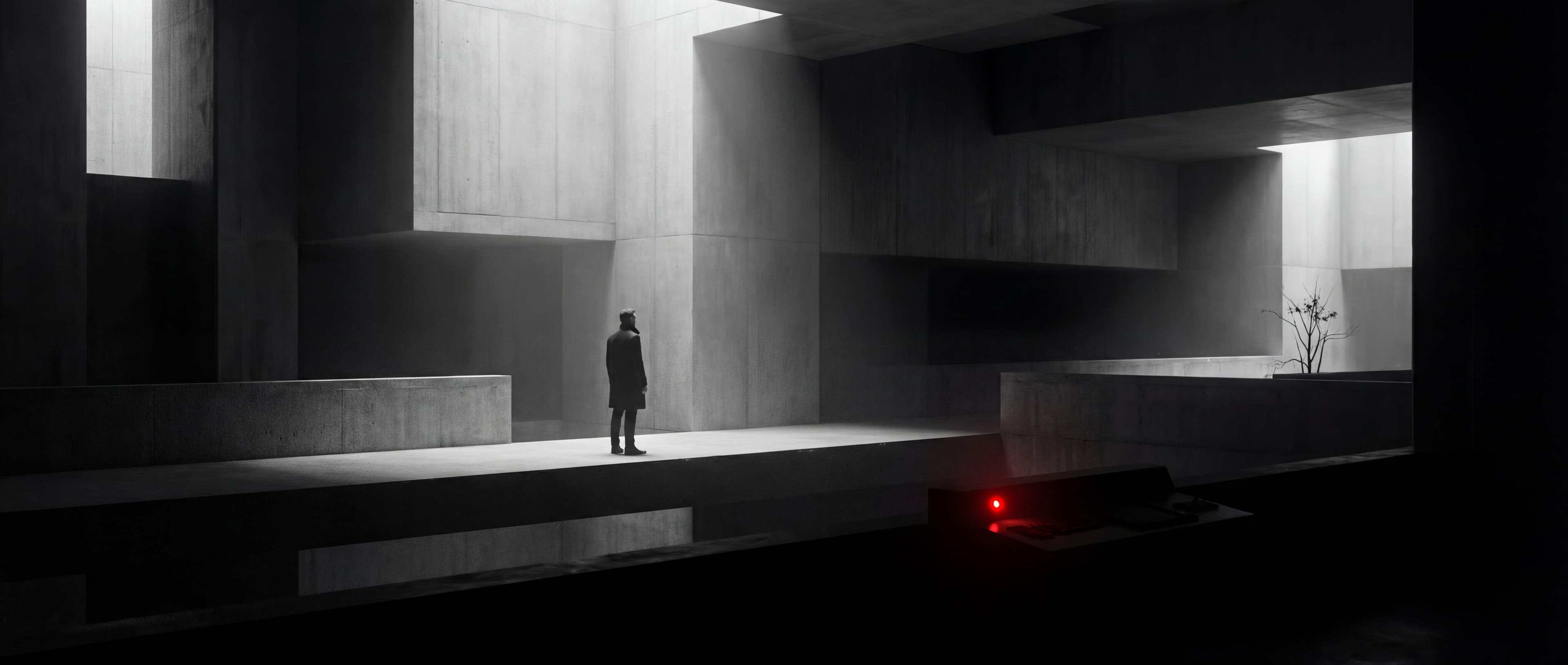
These days I feel the era is in a hurry to explain everything. There is little space left for doubt; if something isn't understood quickly, it gets discarded. Numbers, dashboards, control maps multiply as if the world will finally obey. But a background feeling won't go away: the compass isn't broken, it just points to a place we keep avoiding.
Under that pressure to define everything, the persona becomes a rigid suit. Sometimes it's useful, sure. The ego needs a role to navigate. The problem comes when the suit sticks to the skin and we believe that's all we are. Then life turns into a stage. We perform for an audience that is almost never there. We call it productivity, but often it's fear of being alone with silence.
What saves me is imagining a room without witnesses. It's not a cozy refuge or a romantic retreat. It's an inner place where I can't hide behind my profile, my merits, or my projects. No excuses there. That's where the shadow appears, not as a monster, but as what was left out when I built a socially acceptable self.
The shadow of this era has specific faces: fear of falling behind, addiction to comparison, the feeling that everything should be optimized. When we don't look at it, it turns collective and gets projected. Suddenly everything is "threat," "incompetence," "enemy." What is actually shouting is a part of us that doesn't know how to breathe without performance.
There's another way into the room: the hidden gold. The shadow doesn't only hold what we deny out of shame. It also holds what we deny out of tenderness. Vulnerability, the desire for care, the need to belong without competing. Sometimes the hardest thing isn't to admit our aggression, but to admit our fragility. Fragility doesn't sell, but it integrates.
When the world feels uncertain, the psyche looks for control. Jung said the unconscious compensates. If consciousness inflates with certainty, the shadow brings doubt. If the ego imagines itself self-sufficient, the unconscious pushes symbols of dependence. Not to humiliate us, but to balance us. The room without witnesses is the space where we can hear that compensation before it turns into a symptom.
I don't propose grand rituals. I propose small, honest gestures. Turn off screens for a while and let the body remember its own rhythm. Write a sentence you won't publish. Ask an inner figure a question: "What do you want from me that I don't want to hear?" And wait. Sometimes the answer arrives in a dream, sometimes as a discomfort that takes time to name.
Inner life isn't a luxury. It's the only place where the ego meets the Self without intermediaries. When that meeting is postponed too long, the outer world becomes an endless chase. Nothing reaches, nothing is enough. The room without witnesses is the pause where the chase loses its force.
This isn't about renouncing action. It's about recovering the center. The era demands speed, but the psyche asks for depth. Between the two there is a tension that isn't resolved by more discipline, but by more presence. That's why the room without witnesses doesn't feel like an escape to me, but a way back. Back to a place where there's no need to pretend, where time isn't an enemy, and where the shadow can finally sit at the table.