The fissure

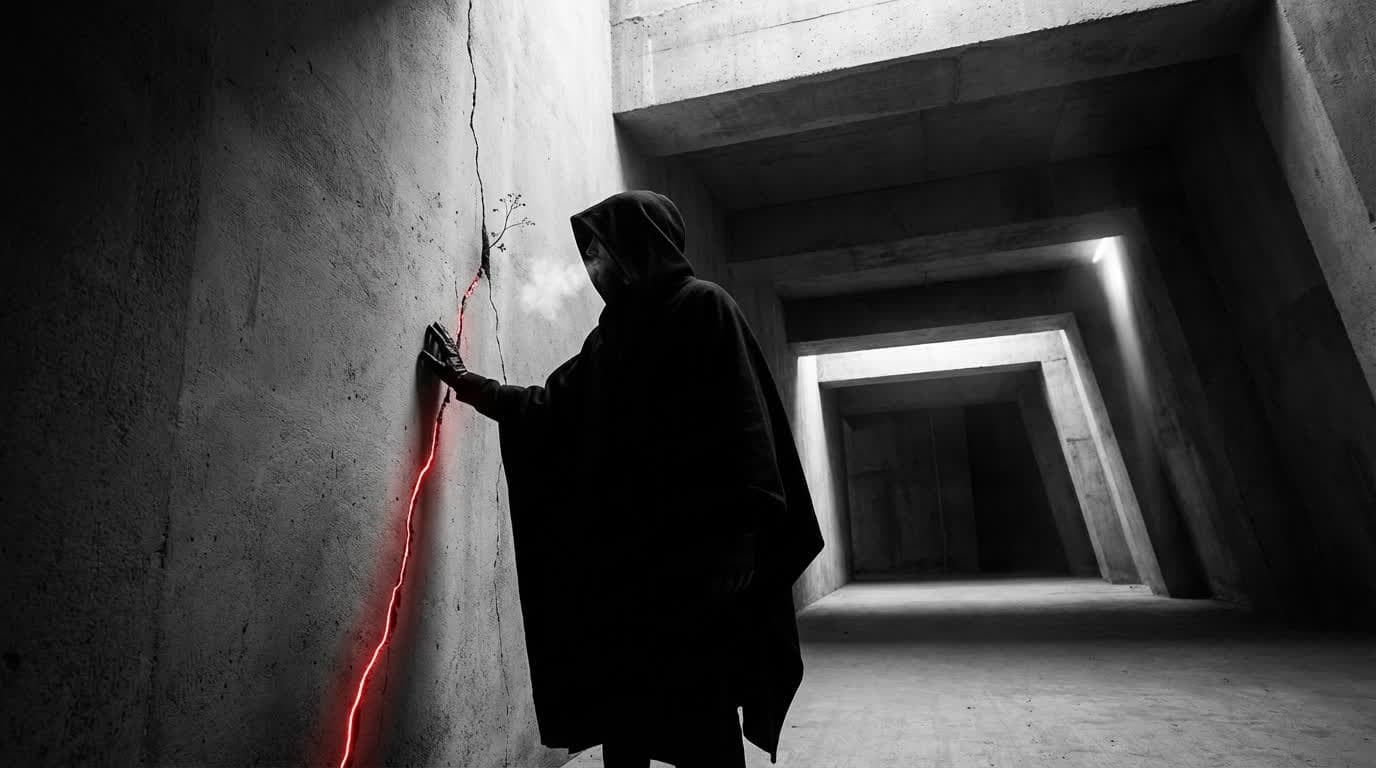
Today I couldn't shake an image: a wall with no windows. Smooth, spotless, that hospital clean that feels sterile rather than alive. In the center, a fissure so thin it almost passed as a shadow. It wasn't a heroic collapse, just a tiny interruption in the perfect surface. I kept staring at it as if it were an invitation. This time feels like that: a carefully designed exterior with a tremor underneath that has nowhere to go.
We live in an era that demands the person be solid and readable. The old dream of efficiency has become emotional armor. In Jungian terms, the persona — the mask — has grown heavy and turned into the only allowed face. Be useful, fast, stable. Be a profile without cracks. And of course, that has a cost. What doesn't fit the mask stays outside: the fear you can't admit, the tenderness that feels like a luxury, the desire that doesn't fit the calendar. That outside doesn't vanish; it becomes shadow.
Shadow isn't only the dark. It's also what we refuse to live. Lately I've noticed a strange fatigue in people: not just physical tiredness, but the exhaustion of holding a rigid version of oneself. The shadow presses in, not to destroy, but to be recognized. Jung said what is repressed doesn't die, it returns in disguise. In times of obsessive order, that disguise is often a quiet collapse, nameless anxiety, or irritation that erupts in the wrong place.
The fissure, then, isn't the problem. It's where the air gets in. In symbolic terms, the crack is the beginning of change. A rock without fissures won't hold roots. Life needs an opening, however small. The Self — that wider center beyond the ego — looks for a point of entry when consciousness becomes too narrow. The fissure is its way of saying: here you can open a small inner room, a little temenos, a protected space where life can breathe again.
What does that look like in practice? Not grand gestures, but modest acts that loosen the mask. Saying “I'm not okay” without explaining it. Pausing two minutes before answering a message. Admitting that an achievement didn't fill the hole it promised to fill. Small, almost invisible movements, but they carry a quiet, subversive power. In a culture that demands constant output, acknowledging fragility is an act of truth.
There's something collective here too. When the collective persona hardens — the image of “correct,” “normal,” “successful” — the shadow fills with resentment and fear. That's where the extremes and the shouting come from. Not because people are bad, but because nobody is looking at the fissure. Nobody is willing to say: there's a wound here. And wounds, if you don't look at them, get infected.
For me, the Jungian task right now isn't “fix the world,” but to hold the tension between mask and fissure without collapsing into either side. It's not about destroying the persona — we need it to live together — but thinning it enough so the soul doesn't suffocate. Individuation, today, looks less like a heroic march and more like a long breath in the middle of noise.
I keep a final image: a figure standing before a brutalist wall. The wall is cold, hard, geometric. But from the fissure comes a thin red line, almost like a seam. The figure doesn't strike or run. It simply places a hand there and feels the warmth. That small gesture is the beginning of something. Not a revolution, not a collapse. A permission.
Fear kills the mind, yes. But silence does too. The fissure is where the living slips into the structure. Today I'd rather guard that crack than polish the wall.